
Roof Paint vs. Roof Coating Systems
Compare ordinary roof paint with a professional roof coating system for tile roofs—how each is prepared, what it is designed to do, and why thin paint can peel in South Florida conditions.
The Real History Behind Roof Painting — And the "Roofs Need to Breathe" Myth
Roof painting didn't start as a marketing gimmick — it started as a genuine discovery. Decades ago, roof painters applying thick coats to tile roofs noticed that paint seeping into the gaps between tiles actually helped hold the tiles down against wind. Through repeated hurricane seasons, the idea held up and spread as a practical, lower-cost way to protect a tile roof.
Traditional roof-replacement companies pushed back hard — and one of their most repeated objections was that coated roofs "can't breathe." That claim is misleading. Most professional-grade coatings, including the elastomeric and silicone-based systems we use, are vapor-permeable: they block liquid water from getting in while still letting trapped moisture vapor escape. Silicone systems (like our Roof Shield formulation) have a somewhat lower permeability rating than pure acrylic coatings, but they're still breathable — which is why a properly applied coating prevents blistering and trapped-moisture failures rather than causing them.
Where roof painting actually did earn a bad reputation: some painters — and some homeowners — painted directly over existing leaks and roof damage without repairing the structure underneath. Covering a problem doesn't fix it; it just hides it. That misuse, not the underlying technique, is what gave roof coatings their reputation problem.
That's exactly why every one of our installations starts with an infrared moisture scan — to find hidden leaks and trapped moisture before any coating goes on. It's also why, over the last decade, most traditional roof repair and replacement companies have started offering similar coating systems themselves — because done right, it works, and homeowners increasingly want an alternative to being sold a full roof replacement they don't need.
When comparing roof coating cost against roof replacement cost in Florida, use project-specific quotes that include roof condition, preparation, repairs, application, maintenance, written warranty, and expected reapplication. A coating may cost less upfront when the existing roof qualifies, but it does not automatically guarantee a lower lifetime cost or longer service life. Get a free, no-obligation roof coating estimate for your property, or see our factory pricing page for guide rates by system and roof type.
6 Problems with Standard Roof Paint in South Florida
These aren't opinions — they're documented performance realities in our climate.
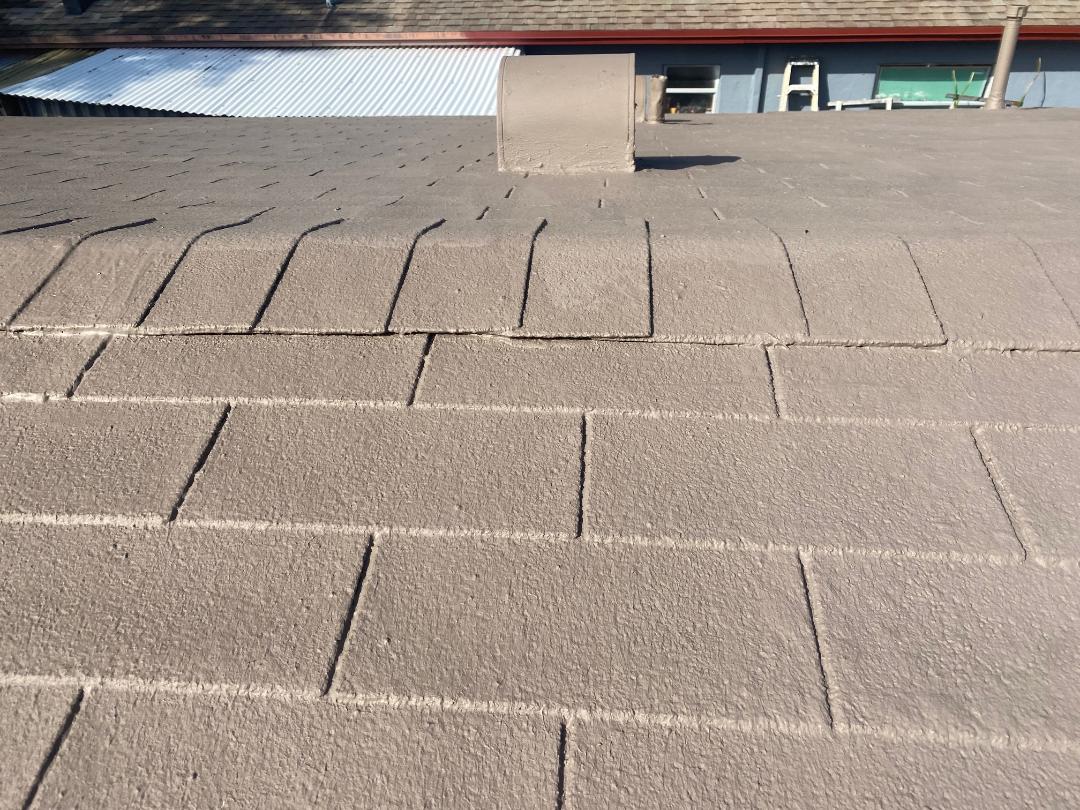
See the Difference on a Real Roof
This is one photo of one roof — a real job in Davie, FL. No staging, no stock imagery.
What a Roof Coating System Actually Does
Our proprietary coating systems — Fungal Shield (RP1), Smart Shield (RP2), and Roof Shield (RP3) — are not paint. They are liquid-applied roofing systems that cure into a continuous rubber membrane.
Side-by-Side Comparison
| Factor | Standard Roof Paint | Roof Coating System |
|---|---|---|
| Waterproofing | None | Full seamless seal |
| Service life in South Florida | Product and exposure-specific | Product, system, and project-specific |
| Flexibility | Rigid — cracks | Elastomeric — moves with roof |
| Wind-uplift documentation | Usually none | Product-specific — review the tested system |
| Algae / mold protection | None | Fungal Shield antimicrobial |
| Insurance documentation | Project-specific | Project and system-specific |
| Energy-performance evidence | Review the exact paint, formula, and shade | Product-, formula-, and shade-specific |
| Warranty | Varies | Varies by product and installed system |
| Long-term cost | Project-specific — include preparation and repeat cycles | Project-specific — compare the full installed scope |
Our Three Coating Systems
Unlike painting contractors who apply a single product to every roof, we match the right system to your specific roof type, condition, and goals.
Our antimicrobial coating system designed to permanently prevent algae, mold, and black streaking. Ideal for tile roofs in heavily shaded or humid environments.
A decorative tile roof paint, waterproof coating, and glaze built for darker colors. Bonito Black — the current tested formula and shade — reaches up to 42% TSR.
Roofshield RP3 is a separate monolithic system with its own product-specific TAS-106 test and installed-system warranty documentation.
Common Questions
Qtile roof paint for dark colors that is the most stable, maybe an all-in-one roof paint, roof coating, and glaze — does that exist?
Yes, but the word stable depends on the tile, existing surface, preparation, coating thickness, and pigment system. Smartshield RP2 is the all-in-one product path for a decorative tile roof paint, waterproof coating, and glaze built for darker colors. Its current Bonito Black tested formula and shade reaches up to 42% TSR; that result does not apply to every color.
QCan I just paint my roof and save money?
You can choose paint, but the lower upfront price does not by itself prove a lower long-term cost. Compare roof condition, preparation, repairs, application, written warranty, maintenance, and likely reapplication for the exact products and project. Neither paint nor a coating should be described as automatically paying for itself through household energy savings.
QIs roof coating the same as roof paint?
No. Roof paint is a decorative surface film; professional roof coatings use product- and system-specific formulations, application requirements, and warranties. Wind-uplift evidence is also product-specific: Roofshield RP3 has separate TAS-106 test documentation, and that evidence does not apply to Smartshield RP2, Fungalshield RP1, or roof coatings as a category.
QDo I need a new roof before I can get a coating?
Usually not. Our coating systems are designed to be applied directly over an existing roof — whether it's a flat deck, barrel tile, shingle, or metal. We conduct a thorough inspection first to identify any areas needing spot repair. In most cases, a coating system eliminates the need for a full replacement entirely.
QWill a roof coating help with my Citizens Insurance?
Insurance and roof-life documentation is project-specific. It depends on the roof condition, inspection, licensed professional, installed scope, and the carrier's current requirements. A coating alone does not guarantee eligibility, continued coverage, or a premium reduction.
QHow long does a roof coating last?
Service life depends on the exact product, installed system, roof condition, preparation, application, exposure, and maintenance. Smartshield RP2 carries a 20-year product warranty; other products and systems have their own separate written terms.
Ready to Stop Painting and Start Protecting?
Get a free roof evaluation from a certified technician. We'll assess your roof, explain which system is right for you, and give you a no-obligation estimate — no pressure, no sales pitch.
Serving Broward, Miami-Dade, Palm Beach, and Monroe Counties · A+ BBB Rated since 1994